News

Page 1 of 41234»

Alex Grey’s Chapel of Sacred Mirrors Closes Temporarily

December 25th, 2008

The Chapel of Sacred Mirrors (CoSM) in New York will close at the end of this month. While the chapel will close with a New Year’s Eve party, the project will not come to an end.

Through the chapel’s corporation and with help from donors, they have bought a 40-acre plot of land in the town of Wappinger, 65 miles north of New York City and just a 20 minute walk from the MetroNorth train stop at New Hamburg. Here they plan to rebuild the chapel and develop an interfaith retreat center. There, eventually, they intend to construct a four story, domed temple to house the Sacred Mirror paintings and provide a place for rites of cosmic consciousness. There will also be studios, workshops, conferences, retreats, offices, visionary art exhibitions and an installation of the Chapel of Sacred Mirrors permanent art collection which has become a context for a growing community.

One of the criteria for the Greys for CoSM’s site selection, was that the land required rehabilitation. On the plot they selected were a number of old oil tanks. This required that the contaminated soil be removed and the surrounding treated.

Chapel of Sacred Mirrors (CoSM map)

Chapel of Sacred Mirrors (CoSM map – click to view)

Founded by the Alex Grey, and his wife, Allyson Grey, the chapel is a curious, combination of art gallery and New Age temple. The main attraction is an installation of allegorical paintings by Alex Grey that, in the context of a carefully orchestrated theatrical environment, is designed to transport paying visitors into states of ecstatic reverence for life, love and universal interconnectedness.

The Chapel of Sacred Mirrors proper is currently a long hall with red walls hung with a series of 20 life size paintings of standing human figures that Alex made in the early ’80s. They include pictures of naked racial types; images of people with skin peeled off to reveal underlying anatomical structures; and figures that have almost completely dissolved into patterns of circulating light. At one end of the hall, a radiant Jesus hangs next to a glowing Sophia. Grey’s 2006 portrait of the discoverer of LSD, Albert Hofmann, is displayed on an easel in the middle of one of the chapel’s other rooms. It’s called “St. Albert and the LSD Revelation Revolution.”

Hundreds have attended the Grey’s regularly sponsored Entheocentric Salon, an all-night party involving, according to the Chapel’s guidebook, “live painting, video projections, local and international DJs and musicians, live performances, lectures and visionary conversations.”

Key to All Optical Illusions Discovered

December 13th, 2008

Humans can see into the future, says a cognitive scientist. The mechanism behind that can also explain why we are tricked by optical illusions.

Researcher Mark Changizi of Rensselaer Polytechnic Institute in New York, says it’s our visual system that has evolved to compensate for neural delays, generating images of what will occur one-tenth of a second into the future. That foresight keeps our view of the world in the present. It gives you enough heads up to catch a fly ball (instead of getting socked in the face) and maneuver smoothly through a crowd. His research on this topic is detailed in the May/June issue of the journal Cognitive Science.

http://www.livescience.com/strangenews/080602-foresee-future.html

Dreamscapes Book and Exhibition – Amsterdam 2008

December 12th, 2008
Dreamscapes 2009 - The Best of Imaginary Realism

Dreamscapes 2009 – The Best of Imaginary Realism

The new Dreamscape book has been released and I travelled to Amsterdam for the book launch and exhibition. The new Dreamscapes 2009 book represents 52 artists working in imaginary realism from around the world and has 164 pages in full color. As always, the print quality is from the highest level.

My friend Ella Buzo from Cabinodd was one of the organizers for the exhibition. She was working with Marcel Salome the publisher and director of the project. It was Marcel who greeted me first as I entered the door to the exhibition. He said he recognized me from images on the internet and welcomed me warmly. And so it was throughout the evening, finally meeting people who were until that time were no more than a data stream on my computer or perhaps images in a book. Meeting all of these artists certainly was one of the things that attracted me to the event, but more overly it was a chance to see a little bit of Fantastic art history in the making.

The book is the third in the Dreamscapes series. I have the two previous Dreamscape books. The project has continued to grow in strength and mature. A large hall was rented to accomodate all of the works for the exhibition. It looked impressive. Dreamscape unites art movements like magic realism, fantastic realism and surrealism under the collective name Imaginary Realism and brings them with various projects to the worldwide and well deserved attention.

I struggled to look at all of the artwork in detail as much of the evening was spent meeting people. What I did see was of superb quality. Amongst the new faces were one or two that I already knew, such as Brigid Marlin, Igor Grechanyk and Rardy Van Soest.

Many artists had brought books and catalogues to give away or swap. I am very pleased to say that I collected a number of them myself, including a copy of Dreamscapes presented to me by Marcel himself. I had also brought my copy of Jon Beinart’s Metamorphosis book along to gather a few more signatures.

Dreamscapes Exhibition - Amsterdam 2008

Ella Buzo, Marcel Salome, myself at the Dreamscapes Exhibition, Amsterdam

With so many artists to talk to time was quickly gone and the exhibition opening came to an end. However we all made our way over to a boat restaurant. Brigid called me over to join her table, with Steven Kenny, Rene Zwaga, his wife and Rardy Van Soest. Again time passed quickly and people eventually made their way home.

Many artists had made long journeys to attend, some longer than mine from Berlin to Amsterdam. The journey was well worth the effort to meet the artists and see their artwork. I hope we see many more such events to come.

Participating artists:
Michael Parkes · Lukas Kandl · Bruno Di Maio · Gerard Di Maccio · Herman Smorenburg · Michael Cheval · Ans Markus · Bodi · Fabrizio Riccardi · Victoria Francisco · Imke Meester · Richard van der Koppel · Jake Baddeley · Bas Sebus · Jolanda Richter · Ray Donley · Gabriela Garza-Padilla Adam Rote · Daniel Merriam · David Bowers · Gabriel Meiring · Igor Grechanyk · Jean Thomassen · Kinuko Y. Craft · Micha Lobi · Michael Hiep · Olivier Zapelli · Patricia van Lubeck · Paul Jaarsma · Reinhard Schmid · Rene Zwaga · Shiori Matsumoto · Siegfried Zademack · Steven Kenny · Wim Kuenen · Zeljko Djurovic · Christophe Vacher · Sjaak Kieft · Helene Terlien · Ton Haring · Peter Gric · Sergei Aparin · Viktor Safonkin · Yu Sugawara · Iurie Matei · Boris Shapiro · Tomasz Kopera · Michael Maschka · Imke Meester

For more information about the exhibition and the new Dreamscapes book visit:
www.imaginaryrealism.com

Satoshi Sakamoto Interview on Lila.info

December 11th, 2008

My friend Satoshi Sakamoto was recently interviewed on Lila.org by Daniel Mirante. It is a good example of Satoshi’s complex philosophies and his unique perspectives. Satoshi also mentions our meeting this year in Kyoto for the International Fantastic Art exhibition.

The complete interview can be read on http://lila.info/art/interviews/satoshi-sakamoto-forms-from-the-void.html

Damien Hirst – The Rijksmuseum – and the Ultimate Bling
December 11th, 2008
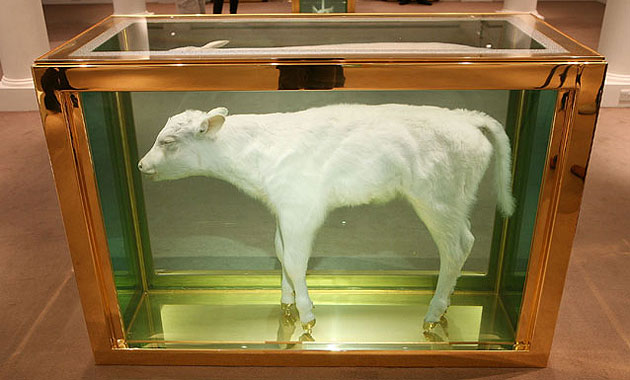
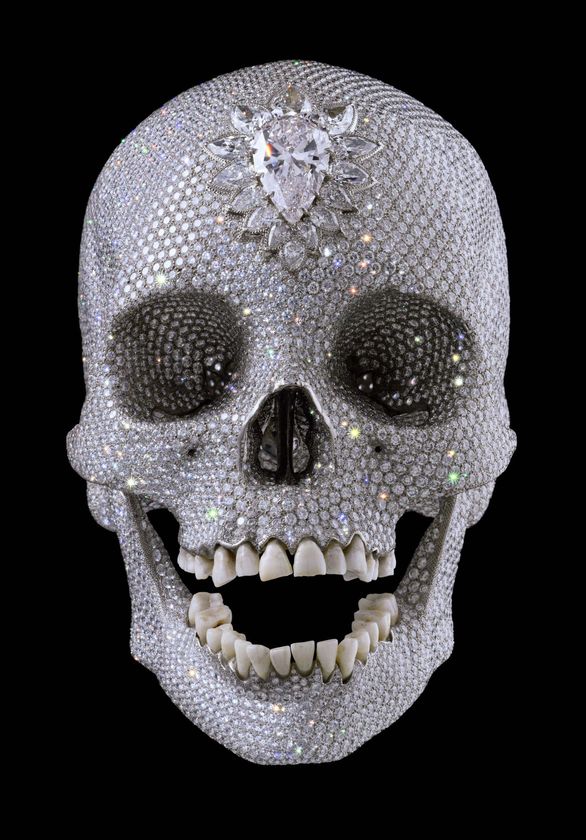
Damian Hirst - For the Love of God

Damien Hirst – For the Love of God

I came to Amsterdam for the Dreamscapes exhibition. With a few hours to spare before the opening, where I would be viewing modern painting masters, I would pay a visit to the Rijksmuseum and see some of the Old Masters.

Much to my surprise and disappointment, I found the entrance dominated by Damien Hirst and a queue. I don’t ever recall having to queue for the Rijksmuseum. The queue was one of those artifical queues you see often see in front of those superficial night clubs, that rate style above substance, continually keeping a queue of people outside for “security” reasons, while also again putting appearance before all else, fabricating a false sense of exclusitivity and popularity.

I made my way about the museum looking at all of the fine artwork and historical museum pieces, until I came across another queue. This time inside the museum, people queued for the special room where Hirst’s diamond skull was on display.

Hirst’s skull is suposedly the world’s most expensive artwork, but this is rather suspect, when you consider that he bought it back from himself. Stranger still, according to the Guardian, up to twenty workers who make his works will not have their contracts renewed even though Hirst’s gallery breaking auction earned him 130 million euro at Sotheby’s in September. Nevertheless, about half his London-based staff were told this week that their contracts will not be renewed.

“It was unexpected, especially after Hirst made a killing from the Sotheby’s sale”, a source told the Guardian.

Whether sacking staff will have much of an impact on the financial health of Hirst’s art-producing company is unclear. The workers are said to be paid only £19,000 (22,600 euro) a year. That amount pales in comparison with the prices paid for works by Hirst.

While I was curious to see Hirst’s ultimate bling, the queue looked rather dismal as well as the prospect of participating in the hype. The Netherlands have been inundated by the propaganda. It seems that not all are sold on the fanfare, especially amoungst some of the Dutch museums competing against the Hirst Rijksmuseum media machine.

Why was Hirst on display in the Rijksmuseum in the first place? Perhaps they were taken in by his comment earlier this year that he, Damien Hirst is like Rembrandt, and so promptly put him on display in the room next to “The Night Watch”.

I circumnavigated the clot of people ignoring the art about them waiting to be admitted into Hirst’s sanctum of superficiality and progressed to the next room. Superficial is the catch phrase here, as superficially the room appeared to be a continuation of museum’s permanent collection. However this was the curator’s attempt to make some relevance with Hirst’s bling by allowing him to select from their collection at his whim. Hello? What is the curator being paid to do?

Hirst seems to be astutely aware of this also, as he seized upon the opportunity presented by curator for him to make any inane comment he desires regarding the artwork he’s selected from Rijksmuseum collection. Is not the curator embaressed, or do they find him so witty? It would seem to be that Hirst is at his provocative best insulting the museum and its curator bald faced, and have them love it. “I will tell you are fools, and have you agree and tell me how genius I am for telling you so.” This is the same tactic with his artwork.

Before finally departing the Rijksmuseum shaking my head, I made a last stop by the Hirst space setup in the garden. Here you can buy all manner of diamond skull merchandise, and if you feel so inclined, leave your comments about the exhibition. Perhaps the museum, was being cautious and testing the waters. Perhaps they weren’t really so confident about their display. Why else ask for visitor feedback?

I left my comments, asking why they feel the need to copy all of the other museums. As a museum for Dutch cultural heiratage, this made them unique. As museum of modern “block buster” exhibitions, they are like all of the other me too Mc Donalds museums francised across the world.

Robert Venosa Interviews Peter Gric

December 5th, 2008

After spending time in the Liminal Village at the Boom Festival where he was exhibiting, Robert Venosa made his way over to Vienna. Here he paid a visit to my friend Peter Gric, who he sat down with and discussed his artwork and a little about Fantastic and Visionary art movement.

The video of that meeting of two great artists was only recently made available on the internet.

James Gleeson – Australian Surrealist – Dies Aged 92

November 21st, 2008
James Gleeson

James Gleeson

I sadly discovered last night that James Gleeson, Australia’s foremost surrealist painter passed away last month, aged 92. Gleeson was an early inspiration and influence on my own artwork. His visions in paint motivated me to render my own.

I would have liked to have met the man, but I’m told by another artist friend who did, that he wouldn’t talk paint, but if you talked psychology with him, he’d happily talk all day. So it was not so strange then, that before I new this crucial piece of information, and having obtained his phone number, that our phone conversation was very brief, but polite.

Gleeson’s fascination with the burgeoning

We Inhabit the Corrosive Littoral of Habit

We Inhabit the Corrosive Littoral of Habit

surrealist movement began in the ’30s and continued growing through the ’40s when the artist’s travels took him around Europe, offering opportunities to see first hand the work of Salvador Dali and Giorgio de Chirico. At this time Gleeson became interested in the writings of psychologists such as Sigmund Freud and Carl Jung. These would become major intellectual influences for his art.

Funeral Procession in a Wounded Landscape

Funeral Procession in a Wounded Landscape

Returning to Australia, Gleeson joined the experimental Contemporary Art Society and began on his own work. Characteristically, his pieces featured naked figures – quite often males – standing out amidst a turbulent background of psychedelic imagery, which often took on the appearance of swirling seas battling even greyer skies. Gleeson’s themes generally delved into the subconscious using literary, mythological or religious subject matter. He was particularly interested in Jung’s archetypes of the collective unconscious.

Siamese Moon

Siamese Moon

During the 1950s and ’60s he moved to a more symbolic perspective, exploring notions of human perfectibility. At this time he increasingly fashioned small psychedelic compositions made using the surrealist technique of decalcomania in the background, to suggest a landscape, and finished by adding a fastidiously painted male nude in the foreground. Many of his paintings had homoerotic undertones, something which reflected on Gleeson’s own sexuality. The ideas for these compositions also saw Gleeson move into collage with his Locus Solus series, where he produced a substantial body of work by placing dismembered photographs, magazine illustrations, diagrams and lines of visionary poetry against abstract pools of ink.

James Gleeson Perhapslestrois

James Gleeson Perhapslestrois

Since the 1970s Gleeson generally made large scale paintings in keeping with the surrealist Inscape genre. The works outwardly resemble rocky seascapes, although in detail the coastline’s geological features are found to be made of giant molluscs and threatening crustacae. In keeping with the Freudian principles of surrealism these grotesque, nightmarish compositions symbolise the inner workings of the human mind. Called ‘Psychoscapes’ by the artist, they show liquid, solid and air coming together and directly allude to the interface between the conscious, subconscious and unconscious mind.

Gleeson’s later works incorporate the human form less and less in its entirety. The human form was then represented in his landscapes by suggestions, an arm, a hand or merely an eye.

In 2003 the Art Gallery of New South Wales exhibited Gleeson’s drawings for paintings. His retrospective in 2004-2005 Beyond the Screen of Sight included 120 paintings and was exhibited in Melbourne and Canberra.

In September 2007, the largest collection of Australian surrealism ever collected was donated to the National Gallery of Australia by Ray Wilson. The collection included various works by James Gleeson.

Gleeson was a member of the first board of the National Gallery and worked hard to develop their surrealist collection. Throughout his life he also worked as an art critic, culminating in definitive histories of fellow Australian artists William Dobell and Robert Klippel. He was also a poet, writer and curator.

Awarded the Order of Australia medal for his services to art in 1975, Gleeson’s talent was undeniable and his effect on the art world ongoing.

His works have been featured at the Art Gallery of NSW, the National Gallery of Victoria and the National Gallery of Australia in Canberra.

I’ve never accepted the external appearance of things as the whole truth. The world is much more elaborate than the nerves of our eye can tell us.” James Gleeson.

Madeline Von Foerster – Waldkammer – Strychnin Gallery Exhibition
November 8th, 2008
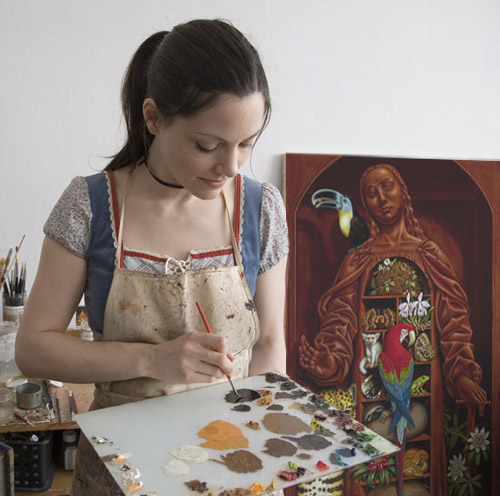
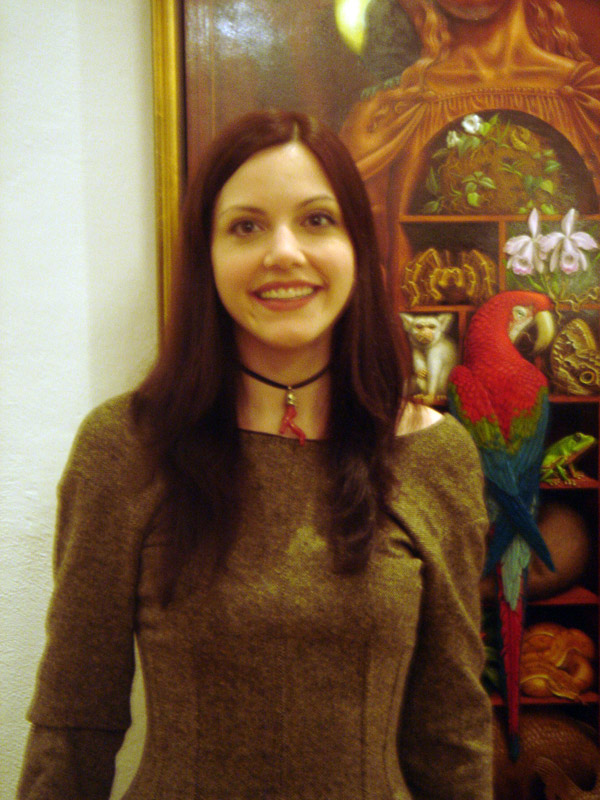
Madeline Von Foerster

Madeline Von Foerster at her Strychnin Gallery Berlin exhibition with her painting “Amazon Cabinet” in the background.

Wait long enough, and the world will come to you. So it seems now living in Berlin. When I had been here years ago, it seemed that Berlin was a hostile ground for Fantastic art, being dominated by all that was contemporary and conceptual in art. Then slowly over the years Berlin has surprised me with a number of exhibitions and artists.

So it was with much anticipation that I awaited Madeline Von Foerster’s exhibition at Strychnin Gallery. Writing about Madeline’s artwork “Amazon Cabinet” was some of the first contact I had with her before her arrival in Berlin. Like many of those in our growing and increasingly intertwined network of Fantastic Visionary artists and supporters, our contact is virtual via electronic communications. Increasingly, this is facilitating real world convergences, from exhibitions in Japan, to painting workshops in Italy and books, such as Metamorphosis 2 in which Madeline will appear.

Madeline’s exhibition was already bustling with people when I arrived just after it opened on Friday evening. So I had to be patient and await an opportunity to say hello to the effervescent Madeline who was of course the center of attention with her artwork.

Having worked a good part of a year on her exhibition, a number were already sold before the opening. Madeline’s artwork exhibits fine painterly skill and technique much like that of the Old Masters. So much so, the German customs officials thought that antique paintings were being smuggled into the country.

After having studied art at the Californian College of Arts in San Francisco, she later expanded her knowledge to more classical techniques when she studied with the Misch Technique with Philip Rubinov-Jacobson at his painting workshops in Austria. The technique is very labour intensive and requires a certain amount of obsessiveness. I joked about this with Madeline as she was often that evening inspecting her paintings for dust and duly wiping them down. Upon asking her if she was the cleaning lady or the artist, and commenting on her obsessiveness, she gestured towards one of the paintings, indicating that this inclination was impart neccessary to create such artwork.

The painting “Amazon Cabinet”, which the focus of her fastidiousness in that moment, had sold at the Art Fair 21. The new owner however had been gracious enough to loan the painting back again for the exhibition as formed the center piece. Madeline is obviously very proud of the piece as it features in many of the recent photos of herself.

Invasive Species II

Madeline Von Foerster’s painting “Invasive Species II”.

Her painting is one of a new series titled “Waldkammer” (Forest Cabinet). The idea came to Madeline one day while in her studio while contemplating her antique cuckoo clock.  She was thinking of the living tree was that cut down to make this curiosity that now hung on her wall. This led her to explore the phenomenon of the Cabinets of Curiosities, or Wunderkammern.

The concept of such cabinets was originally an invention of the age of Enlightenment and the Baroque, where wealthy lords and patricians created collections of a wide variety of objects displaying the multi-faceted “wonders” of God’s creations, especially from exotic colonial territories. Coral, minerals, taxidermy, and the like – were lovingly and often fetishistically contained and displayed. These went on to form the basis for many natural history museums, and the approach of science to categorize things and place them neatly in their boxes.

The “Waldkammer” series consists of nine paintings that explore humanity’s often destructive relationship with nature and the crisis of deforestation in particular. These painted wooden cabinets allude to the once-living trees that were their source: Some are carved into the shape of women personifying the trees as living things. Meanwhile, the “curiosities” displayed are actual species, dependant on the trees for survival.

Madeline’s exhibition catalogue goes into much more detail about each individual piece and the animals and plants represented therein. The catalogue was printed though print on demand (POD) with Lulu.com. I have noted a growing number of artists taking advantage of this cost effective option to bring their artwork to print. I of course purchased a catalogue and had it signed. Her signature is almost as much a work of art as her paintings.

One can be drawn into Madeline Von Foerster’s detailed and finely executed curiosities of her “Waldkammer” series at Strychnin Gallery Berlin from November 7th until December 7th.

Berliner Kunstsalon and Contemporary Art

November 2nd, 2008

Art fairs, I’ve seen a few of them. The Berliner Kunstsalon I have attended a number of times, it’s first two years and now this year. In the beginning there was much fresh and interesting work from many of the local artists who were marginalized in the Berlin art market. However since then it has transformed into the same banal copycat pap seen at all of the other art fairs.

It’s one saving grace this year was a generous soul who gave me his entrance card as he was leaving. He obviously took pity on anyone paying the eight euro entrance fee for an art fair that was totally underwhelming.

Soft gay porn seemed to make a popular showing along with the ubiquitous hastily assembled installations. While many of these mundane artworks show no hint of any thought, you of course would be derided by the art intelligentsia as ignorant and uneducated.

My friend Garth Gregory attended the opening and confirmed that the Berlin art circle spent their time discussing concepts. This is being apparent by the lack of time devoted artworks, hastily shot photos, out of focus and poorly photoshopped; offering the most inane of scene or topics, lacking any sense of composition. If you want a real challenge, try and look at the leatherman who has his todger out, and try to keep a straight face.

Technique is handwork, and therefore out, out of fashion, out of the circle of whit and intelligence of the postmodern contemporary art world. This is painfully evident in the paintings on show. No one dared raise their standards above anything mediocre lest they be labeled a craft worker. If you work with your hands too much you obviously don’t spend enough time thinking, and therefore too much time wanking.

Anja Brinkmann who attended the Berliner Salon with me made and astute observation, as we took a restive pause from trekking from floor to floor of the old power substation, warming our bones and hands on the few heating radiators to be found in that cold building. She reflected that if art reflects the zeitgeist, then what we had just viewed was indeed a mirror to our current world situation. Currently we face a crisis, (one of many) in an international finance system that is built on nothing tangible, only concepts and possibilities; the unmanifest, in short, nothing.

The populace is so anesthetised from the media assault we live in, where anything is viewable and entertainment now, shock and outrage garners little more than a whimper. Any fetish may be now labeled as art. Thus we are left with soulless banality as the pinicle of contemporary art that needs the constant assistance of concept, a blizzard of words, which like the natural phenomenon, obscures any sight and direction.

Should you be brash enough to state the obvious and name it as the emperor’s new clothes, then obviously your intellectual rigeur and wit is below par. There is a joke that is being had and snickered behind the hands of the arts intelligentsia. The joke is that clueless people looking to invest in the next big thing will buy anything, and the quest is who can exceed the others with the biggest price tag for the most pointless things sold. Banalities and whimsical curiosities are now equated with the Old Masters, because were they not also interested in profiting from their patrons who were also following fashion dictates?

All jokes repeated conceitedly, bore the audience. And this was evident as the Berliner Salon audience filed through each room barely pausing to view or engage any of the artworks. The party was over on the opening night as was evident from the dull looks in the eyes of gallerists and artists who stood listlessly by their artworks. We’d missed the party and missed the joke, by expecting so see “serious” artwork and anything of note.

Dr Sketchy’s Anti-Art School

November 1st, 2008
Dr Sketchy

Lethal Lilly and Hedoluxe pose at Dr. Sketchy Berlin

Tired of life drawing? Tired of drawing the same potatoes that recline on a couch? On Saturday Anja and I sought out different schooling for our figure drawing needs. We enrolled in Dr. Sketchy’s Anti-Art School, closeted away in a small club, hidden from street view, in the Graefekiez of Kreuzberg, Berlin.

Dr. Sketchy is both a burlesque cabaret and life drawing event originating in Williamsburg, Brooklyn at the Lucky Cat. It was founded in New York City in 2005, by illustrator and former artist’s model Molly Crabapple and illustrator A.V. Phibes.

Our headmaster for the evening was the very dazzelling Hedoluxe and his assistant Laura. Hedoluxe’s stated mission is to save you from boredom, ugly clothes, and to make your life beautiful. Our models for the evening were Clea Cutthroat, Lethal Lily, Mad Kate.

Thrown in to the mix was Tin Tin. He wasn’t there as one of the performers, but rather like the rest of us, to sketch the evenings proceedings. Yes, you did read correctly, Tin Tin. It was the living breathing Tin Tin, the only thing he was missing was the little white dog.

While the evening took on something approximating normal life drawing sessions, starting with shorter poses, and then progressing to longer ones, it was intersperced with burlesque acts by our models. There were also a number of small prizes given away in drawing competitions.

All in all it was a fun relaxing evening and a refreshing change from the normal run of the mill life drawing sessions. If you google Dr. Sketchy, you will find him in various cities through out the world.
There could be one around the corner from you.

Page 1 of 41234»
  • Categories

  •