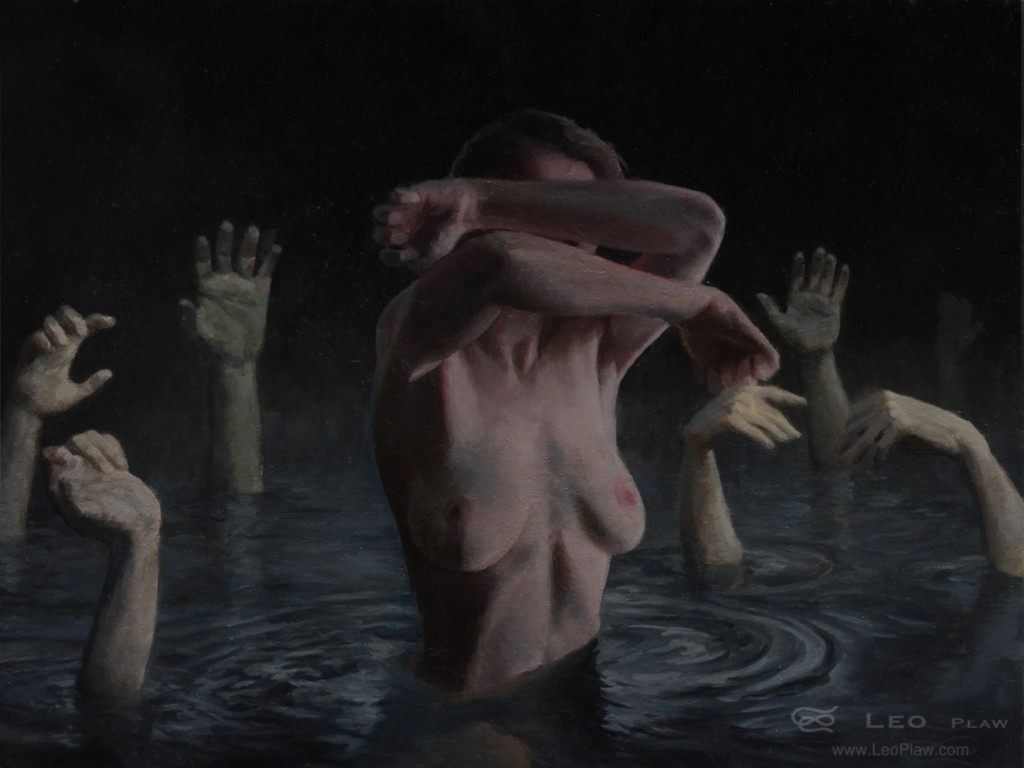
Kuba dropped in to lend a hand. (photo: Timea Tallian)
Since December last year I have had my artwork hanging in Dancing Shiva on Neubaugasse in the Vienna 7th district. With exhibition season having begun, it was time to take my artwork down in preparation for sending them off to far flung destinations once again. But more about those exhibitions in future articles.
Since the Dancing Shiva space and team are to be treasured, I did not want to see the space on the wall fall idle, and suggested to the owner of Dancing Shiva, Riki Hinteregger, that she have fellow Australian artist, Kuba Ambrose hang his artwork there. Both Kuba and Riki liked the idea very much, and so it was agreed.
Kuba came in to lend me a pair of extra helping hands to take down my artwork, and a few days later his went up. This all worked out very well, as there was extra influx of people into Dancing Shiva that following weekend because of the street festival.
It was a great chance for me to finally see Kuba’s oirginal artwork after enjoying and following his creativity on the internet all of these years. I first saw Kuba’s artwork when we were both published in the “Angle Circus” magazine that our mutual friend Jon Beinart was working on. Now, years later after many adventures, and many paintings later, we both have ended up in the same city, Vienna. It has been pleasure to finally meet and to get know him.
I would like to thank Riki and her team for giving me this opportunity and being ever so friendly and helpful. I would also like to thank Celene Venosa for introducing me.
If you are in Vienna, take the time to drop in to see Kuba’s artwork and grab something delicious and healthy from Riki’s cafe kitchen at the back for the store and do something for your mind, body and soul.
Dancing Shiva
Neubaugasse 58
1070 Vienna
Austria
+43 1524 7843
]]>
Vienna Art Academy, Schillerplatz
This past weekend I attended the open studios (Rundgang) of the Vienna Academy of the Fine Arts (Akademie der Bildenden Künste Wien). This is the Austrian art academy that produced the likes of Egon Schiele (1890–1918), Otto Wagner (1841–1918), Rudolf Hausner (1914–1995), Arik Brauer (* 1929), Ernst Fuchs (* 1930) and Gottfried Helnwein (* 1948). It also famously twice refused a young Adolf Hitler admission as a student. Who knows how the world might have been if they had accepted him.
While from the outside the main building on Schillerplatz in central Vienna still retains its appearance and charm from the outside, once you step inside it quickly becomes apparent that it is otherwise. Along with thoughtless modern “functional” modifications, the studios are showing the wear and tear of 130 plus years of use, abuse and plain neglect. In the halls where the public are likely to walk, the original decorative works have been kept in order, but step off onto ways more oft tread by students you see the neglect and disdain for the bygone era.
This is what typifies this once grand art establishment. In the unending push to remain abreast with the current art trends, the past is cut off and cast aside as worn out worthless rubbish. That is, unless, it earns some money, like the Painting Gallery, which houses valuable Old Masters artworks from Rubens, Rembrandt, Van Dyck, Hieronymus Bosch and Titian.
What is sad, is that the work that is being produced today in this establishment, is no different from that I have seen in other institutions ten years ago. Contemporary art has become stale and stagnated. Most of the works on display look like last minute afterthoughts, thrown together in a panic before the public arrives in the following days. It also led me to wonder, just what do the students do with their time there, more so the painting students. With the architecture and printing students, it is evident that they do commit time to their work.
The lack of skill, craftsmanship, time and therefore thought is evident in the other works. Penises appeared to be a popular theme amongst male and female students alike. Are they struggling with some sort of erectile dysfunction with regards to finding, firm controversial, ground breaking artwork that provides some penetrating thrust? It appears so limpid that even outright pornography fails to make anyone blink. (Or is this more of a statement on our society today?) I passed one large painting of a graphic homosexual foursome and happened to overhear a woman interpreting the “deeper meaning” with convoluted explanations, of what simply is just a painted copy of a photo.
So it bemuses me to hear people ascribe some greater meaning to something and not call something out for what it is, for fear of appearing “uncultured”, intellectually inferior or closed minded. All I see is the emperor’s new clothes.
But who am I to say what art is or not, what is good art or not? When I start to make such judgements, am I no better than fascist regime of Academy’s most famous reject? I reflected upon this as I walked the halls of this building thinking of how the then regime expunged the “undesirables” from the university. There is tenuous line that one walks when one starts making such qualifying judgements. I think perhaps because of this dark period in Austria’s history, in such institutions, it is anything goes, for fear of being smeared with that taint.
In the headlong rush to forget the horrors and absolve itself of the war, the Austrian nation embraced all that was shiny and new from American modernism, casting aside anything that had a hint of classicism, which had been co-opted and pressed into service of the swastika as any other “resource” was. But then there was the new demon of Communism. They also ascribed to “classical” or technical expressions of art. Therefore, anything that was executed with a degree of skill, or appealed to any sense of ideal or narrative, was seen in the same light and thus doubly “evil”.
Thus we arrive at where we are today. Anybody and everybody is an artist. Anybody that works with a degree of technical skill, can be safely sanitised as “craftspeople”. There is a prejudice that comes with this, implying that one is dull and simple when working with their hands. Why then would you, when we live in this age of technological wonders, work thus, when it can all be automated for you?
Even thinking can be relegated to the great network in the sky. It was thought that with the advent of the internet that we would all become a much more enlightened and tolerant world, when presented with so much information and choice. Rather, what appears to have happened, is that we have largely lost the ability to critically think. Memes sweep the internet, with people forwarding it on, blindly accepting what is on their screens, often not even bothering to click the link, let alone research some other sources to see if the “information” does indeed add up to facts. The 2012 end of the Mayan long count calendar is a case point example.
In this age of manufactured everything, even the artists no longer have to produce their own artwork. Damien Hirst made the claim that he is like Rembrandt. Yet unlike Rembrandt, he does not produce his own artwork. While there is indeed a long tradition of Old Masters having apprentices toiling away on the hack work, the Masters did at least learn their art form first and thereby direct their students. Sadly I think few of the Vienna Art Academy would even be able to do what Hirst would require of them.
Hence there is a “market gap” that is being filled by private art schools. I personally know a Berlin art school (Bildende Kunst und Gestaltung in Berlin) that pick up many students because the official art institutions are not teaching the basic crafts of art production. In Vienna itself there are also traditional options for learning the skills of painting with Michael Fuchs (son of Ernst Fuchs), or in the near future the Vienna Academy of Visionary Art. There are of course, many other schools and artists offering private tuition.
There are art universities that still exist in the world where technical execution still has a place. Unsurprisingly, many are located in those former “evil” Communist countries where traditional skills were still taught and practised. The Leipziger Schule is great example, attracting students from all over Europe. Former DDR professors such as Werner Tübke played a great role in establishing the school as a leading light.
I think where the majority of educational art institutions are wrong in their direction, is their focus on competition. Art students are being processed and manufactured into competitors in the art market. The art market is a direct result of financial speculators looking for something to “invest” their money in without all of the legal restraints that are imposed upon other regulated industries.
In this competitive push that we see everywhere in the world today, quality has suffered, in the name of profit. Whether it be the products we purchase or to our very quality of life that now suffers because environmental abuse, because competition focused on profit come first beyond all else.
Alan Moore I believe has a good perspective on the necessity for skill and craft in our current age.
“Why is the idea of craftsmanship significant at this epochal moment in time? Because it is about shaping our future and the ‘engaged’ craftsman brings the full power of humanity to bear upon their work. Their hand is guided by their eye, informed by their creative mind; their productivity the act of unique creation. Indeed, the master craftsman is adept in using a philosophical framework, as well as tools and materials, to deliver useful things to the world. But more than that, the craftsman must be open constantly to new ideas; they are essentially always in beta. Therefore, we cannot engage with our uncertain non-linear world with the linear and inflexible orthodoxy of logic alone. The craftsman’s critical eye and creative mind is vital to evaluating new possibilities; they must be open to new ideas, information, tools and materials to make things that enable humanity to flourish. This approach is inherently more creative in that it synthesises all aspects of what make us truly human.”
]]>

“Temptation of St. Anthony” Max Ernst
It’s a Tuesday night in Vienna. What to do? Go to the premier opening of the Max Ernst retrospective exhibition in the Albertina, of course. Thanks goes to Celene and Jutta Venosa for making this possible. Otto Rapp and Timea Tallian were also there to gaze, point. Pick the artists! The five of us kept the security on their toes, nervously hovering in close vicinity, as we peered and scrutinized, with our noses barely centimetres from the paintings.
I’ve long been a fan of Ernst’s decalcomania period, but Otto had a grin from ear to ear and a sparkle in his eye. The Albertina exhibited 180 paintings, collages, and sculptures spanning Max’s artistic career. I think all of us were less than enthusiastic about his earlier works. But as we progressed through the exhibition, arriving at his frottage, decalcomania and later paintings our interest spiked along with animated discussions. So much so were we engaged in the artworks and discussions, I think we came to hardly notice throng of other visitors milling around us and the artworks. To some extent, I think we ended up owning the exhibition.
I have seen a limited number of Ernst’s actual works before, and so with this expansive exhibition, it was a wonderful saturation. Curiously what I noted, was that in his earlier periods, his colours were muted, or more rather a lack there of. Black and brown was everywhere to be seen. And then, he started to discover colour. Perhaps he started come to understand the full vehicle of expression that painting could be, as by the last few rooms of the exhibition, his works were positively luminous.
Ernst could apply the full range of his experimentation and techniques to produce some outstanding works. Many of these I have never seen printed in any book or catalogue. At the opening speech by the Albertina director, he made it apparent, why this was so. Because Max never consistently stayed with any period of painting for any length of time and was constantly exploring new artistic territory, it makes it hard for museums or curators to box him in. So, the majority of Ernst’s work still to this day remains in private collections.
It was a fabulous evening, with exhibition definitely one of the highlights of this current adventure in Vienna. If you happen to be in Vienna while the exhibition hangs, go and see it!
Max Ernst Retrospective Exhibition
Albertina Vienna
Austria
23 January – 5 May 2013

The magic of juxtaposition. Do you see it?
It has happened before. Those moments of empty minded clarity, when not much is happening, lounging on the obligatory comfy studio sofa, looking at the artwork. While to some, it may not look like much is being done, sometimes this meditative space is absolutely required for the successful completion of an artwork.
And then it happens. As you gaze on the work in progress, your eye wanders and suddenly where once it was never apparent before, the painting behind or near that in focus, also comes into focus, and a synergy springs into life.
It maybe the forms, sometimes one painting literally flows into the other. Other times, it is colour combination sets one off on a new crescendo of colour.
And so it was recently here in my Vienna studio. Two unrelated paintings suddenly took on a new meaning together. I won’t say how or what the outcome will be. I know what that is in my mind’s eye.
It never ceases to amaze me from what unexpected corners inspiration is waiting to be found. Only if you look. And look with an open uncritical mind. Then the Muse speaks, and you follow her command.
]]>
I recently did a version of an earlier painting of mine in pen. It was interesting revisiting such an early work, because when reworking it as graphic, I am paying attention to the details. I am therefore thinking about how I would do the painting differently if I had painted it today.
I think the ink drawing comes up nicely in comparison to the original painting, which I still have. Upon reflection I find it surprising that I still have such an early work in my possession as I eventually sell everything that I paint. I’d say that is a fairly good success rate.
What was also surprising was when I posted the graphic to my Facebook page, that some one who had bought a print of the painting from me, when I used to sell on the street corners of Brisbane many years ago, commented that he still had the print. I was pleased to learn that he still had the print. It also made me wonder, how many other people out there still have my prints.
So now, some one has the chance to own the original drawing I made, as I am selling it on eBay.
]]>Now I find myself in Vienna and I am on the hunt for good coffee. Vienna, famed for its coffee culture and coffee houses, so far has disappointed. A Latte is half foam, in a glass that is already small and equally so is the flavour lacking.
Georg, one of the Passenger Espresso crew gave me a list of Vienna coffee shops to explore. But there appears to be a catch. Since Vienna is an ardently Catholic town, there is not much of night life culture, and certainly little is open or moving on a Sunday, albeit in the tourist areas.
Ah Berlin, how you have spoilt me.
I will report back on my findings. In my search I came across Der Espresso Freak blog. He seems to have done a bit of exploring in Vienna, so I will be taking a look at his list also. I’ll also have to point him towards Passenger Expresso
]]>So, some six months later, where there were once small water craft were people cavorting on the ice. Some dusted off their ice skates, others took to walking, I took my bicycle. There was adequate snow cover on the ice that I could get traction. It is an interesting to be standing where you normally can’t and to look at everything from a new perspective. It is also interesting to see how people use this new found public space.
There were small ice hockey areas, along with a few strips where you run and then take a slide. However, perhaps strangest of all was the sounds of Summer that had returned to this spot. Someone had hired a small truck and driven it into the park that borders the canal and set up a sound system, a grill with sausages and hot mulled wine. All of this was then completed with a disco ball and people gathered for the beats. However, to my observation, I think most of the movement was more to keep warm than any real form of dancing.
So, here I am now, with our first snow for this Winter and some biting subzero temperatures. I can happily announce that the repairs have succeeded in keeping my warmer and happy.
To amuse me a little more, Mr. Frost has paid me a visit and shown me his own artistic abilities on my studio windows in the form of some very intricate ice crystal patterns, more often referred to as “Eisblumen” (ice flowers). So when you wonder at these images, wonder at how cold it is outside.
And yes, for those of you who live further east in Europe, or up there in Canada, the temperatures here in Berlin are a walk in the park.
]]>Hamburg artist, Dennis Konstantin will be joining me at the opening. Many thanks must go to Cornelia Mensdorff-Pouilly for getting us into this exclusive event.
More information about the exhibition and its opening times can be found on Fantastic Visions.
]]>
GENSO exhibition
I am in Paris to attend two exhibitions. The first is the GENSO exhibition organised by Shoji Tanaka and Hugues Gillet. It is two years ago since I was last in Paris when I exhibited with Shoji’s group, the IFAA from Japan. This time however, I will be a visitor instead. I look forward to seeing Shoji again and to also enjoying the quality exhibition that he has organised. He and Hugues, a Paris native, have assembled an impressive array of artists, including the likes of Claude Verlinde, HR Giger and Gérard Di-Maccio.
The other exhibition I will be visiting is the “Phoenix and Dragons” exhibition organised by artist Lukáš Kándl and his wife Françoise. Lukáš’ exhibition projects involve a select number of artists. The invited artists then work to a specific theme.
Through an number of email exchanges I organised for Shoji to meet with Lukáš and Françoise as their exhibitions are happening in very close time frames. I felt they all have similar aims and would benefit from meeting each other, and if they take a liking to each other, then perhaps more opportunities will be opened to the each other’s projects. I am very much looking forward to seeing how this meeting works out.
I am also very much looking forward to visiting Paris again.
]]>