Laurie Lipton – Love Bite Print
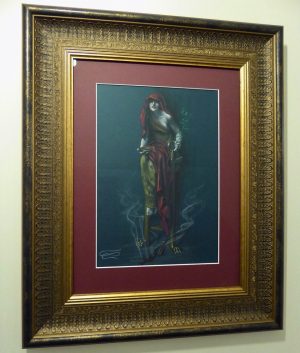
October 11th, 2011One of my favourite artists and master draftswoman, Laurie Lipton, has just released a limited giclee of her most infamous image, LOVE BITE. There is more information on Fantastic Visions.
One of my favourite artists and master draftswoman, Laurie Lipton, has just released a limited giclee of her most infamous image, LOVE BITE. There is more information on Fantastic Visions.

Tim Roosen and Isabelle Hackars
This past Easter weekend artist and gallery owner Tim Roosen paid me a visit in my studio while he was here on business in Berlin. It was very fortuitous as it meant that I could give Tim at least one of my paintings for the forthcoming “Light Fantastic” exhibition at his NovaBelgica Gallery in Belgium.
The second painting that I intend to send is still in production and the clock is ticking. There are a few more layers to add yet.
I will be exhibiting alongside the following artists.
Christine Morren, Claus Brusen, Jacek Lipowczan, Krzysztof Izdebski-Cruz, Magda Francot,Marcin Kolpanowicz, Olga Gouskova, Peter van Oostzanen, Raoul Chanet, Sigrid Nepelius, Tommas Jorgensen, Jef Bertels, Christien Dutoit, Dirk Bosschaert, Els Wenselaers, Roland Menten, Steve Kirkham, Jo Pirard and Tim Roosen.
The details for the exhibition are as follows.
Opening: 13th May 2011
Closes: 19th June 2011
NovaBelgica Gallery
Wildebamp 19
B-3800 Sint-Truiden
Belgium
Tel: +32 (0)495 689485
I can’t say definitely that I’m there yet. As I sit on my comfy studio sofa (many thanks Lia!), I contemplate the day’s work. There is something starting to take shape, a tantalising more complete definition. Extend this here, darken that there, bring this colour in there and viola, there is the final painting. Ah, but some hours, perhaps days or even a week or two to go yet.
“When do I know when a painting is finished?”, I’ve often been asked. It might seem like a silly question, but often the way I work, there is no preliminary sketch or reference materials that I’m working from. It all comes out of my imagination and what is already there on the canvas waiting to be discovered. It is certainly not a new way to work. Even many non artists have laid on the grass and gazed at the clouds in the sky and imagined animals, faces or whatever. As a boy, I used to do it a lot with friends. We all took delight in trying to identify the visual fantasy of the other. It was sometimes very surprising how differently some one else saw the same thing. I still take pleasure in this when people discover something in my own work that I haven’t seen.
Artistically, I’m not alone in this method of visual inspiration. Everybody is familiar with the results of Dalí’s paranoic critical method, whereby one thing becomes another if you look at it in a different way. Even Leonardo Da Vinci was fond of the day dreamer’s gaze, or the thousand mile stare.
“It is in my opinion not useless if you pause in the realisation of pictorial forms and look at the spots on the wall, at the ashes of the hearth, at the clouds, or in the gutter: on careful observation, you will make wonderful discoveries there, which the genius of the painter can turn to good account in the composition of human and animal battles, landscapes, monsters, devils and other fantastic things which you can use to your advantage. These confused things awaken the genius to new inventions, although one must have learnt well how to do all the parts, especially the limbs of the animals and the forms of the landscape, its plants, and its stones.”
From Leonardo Da Vinci’s treatise on painting.
So here I am staring at my painting, filling in the gaps, or rather, it is filling in the gaps for me. But then I come back to myself, sitting on the couch, taking a deep breath I quit my repose and walk to the palette and brushes. Now its time to fill the gaps with a brush and paint.
I was recently asked by an online friend and fellow artist about shipping artwork overseas to an exhibition. In the course of our correspondence, I came to the conclusion that the exhibition was not a good deal for the artist. All costs, shipping and insurance, risks, damage, loss and theft lay solely with the artist. Then on top of that, there was an entry fee, supposedly to pay for the exhibition promotion, albeit a small one, and the final show stopper was, no selling opportunities.
Now, I’ve done my fair share of sending artwork away to likewise exhibitions. There was a point at which the stress of sending the artwork, getting the artwork back and all of the attendant costs, and no sales, just didn’t add up and made no financial sense. Oh, but you could say that it furthers my career. But how does this further my artistic career when I have to do other work to sustain its costs?
The reality is, working as an artist, you are working as a small business. As such, you should be making a profit. What happens to businesses that don’t make a profit? They go out of business. Its incredible the number of exhibition organisers that don’t even think of this perspective, but they are certainly thinking of their own profit or furthering their careers.
Both artists and the organisers often seem to lose sight of the fact that they are actually entering into what is usually a short term business partnership. The artist provides a product (yes, don’t choke, artwork is a product), and the organiser provides the means by which to sell. To ensure that we don’t have any nasty disagreements when something goes wrong, we put everything down in writing, commonly called a contract. That way everybody knows what the other expects of the other. Contracts are there to make sure things DON’T go wrong, not for after things have gone wrong, then it’s too late. Contracts aren’t scary things either. All contracts are open to negotiation, UNTIL you sign on the dotted line. If you don’t like particular points of the contract and the other party won’t negotiate, then, don’t sign. Simple, no dramas, no bad feelings.
Think of contracts as a written agreement detailing a list of questions and answers. If not all of your questions are answered, then you need to ask for the answers to be added in writing to the contract. Be thorough. If the organiser starts to squirm, or protest with phrases such as, “don’t you trust me?” and the like, then you know not to trust them and to walk away, because they are not taking your concerns seriously. And it doesn’t take much imagination to conclude how co-operative they will be when something does go wrong.
What questions and answers should you be considering? Following are my suggestions.
An exhibition is far more worthwhile if you are in attendance with your artwork, for sales and networking. You can then also see first hand how your artwork has been hung and signed.
If there are no sales opportunities from the exhibition, making it purely a vanity exhibition, what are you really getting out of this exhibition other than stress and costs? Something to write on you C.V. and website? You can do that without sending or spending. Remember, your art has to be sustainable, you need to earn from it, otherwise it remains an expensive hobby.
Do not be pressured to send either. Even if you’ve been “chosen” to participate, re-read all of the above points and make a calm boring practical decision. Who does the exhibition really benefit, you or the organisers?
Whatever packaging you use for shipping must be durable and reusable for return if your artwork does not sell. The packaging dimensions and weight will also contribute to your shipping costs. There are also often limits to the size and weight. Make sure you check for these restrictions with your chosen postal service or shipping company.
By all means do as you see fit. Some of the above points I had to learn myself the hard way. Now with experience and hindsight, I’m more selective about the exhibitions I choose to exhibit in.
Exhibitions are a dime a dozen. Exhibitions that are of real worth are rare (depending on where you are in your career) and only these deserve your energy and attention.
Remember, YOU are the artists, YOU are the star of any of these shows, and you should be treated accordingly in a professional manner that furthers your career.

In this painting of the Pieta by William Bouguereau (1876), the artist uses the full range of value at his disposal. Even on the figure of Christ, Bouguereau used a broad range of tone. The brightest lights on the skin are a 9; the deepest shadow on His body, a 2. Christ's loin cloth contains pure white (10), and Mary's robe, which surrounds Christ's outline and separates the Two from the background, is black (0).
Via Chet Zar on Twitter I read a very illuminating and insightful article, “Grey Matter” by Matthew Innis, on managing tonal values in your paintings.
Matthew goes on to explain a couple of tonal scales that can be used to bring extra visual and emotional impact to your images by working with the balance of light and dark. He provides a number of step by step examples. Once you can master tonal value adjustment in your head, you are then freed from the constraints your source material may have on your final work.
For us with the access to image manipulation software such as Gimp or Photoshop he shows us how we can process the images and play about with the tonal ranges in a more must have it now digital fashion. Can you imagine doing this with manually painting your own examples and the time it would take? But perhaps then we’d learn it more thoroughly.
Even if you are short on time to paint your own example exercises, it is well worth the time to read the article.