News

Page 1 of 11

Damien Hirst – The Rijksmuseum – and the Ultimate Bling

December 11th, 2008
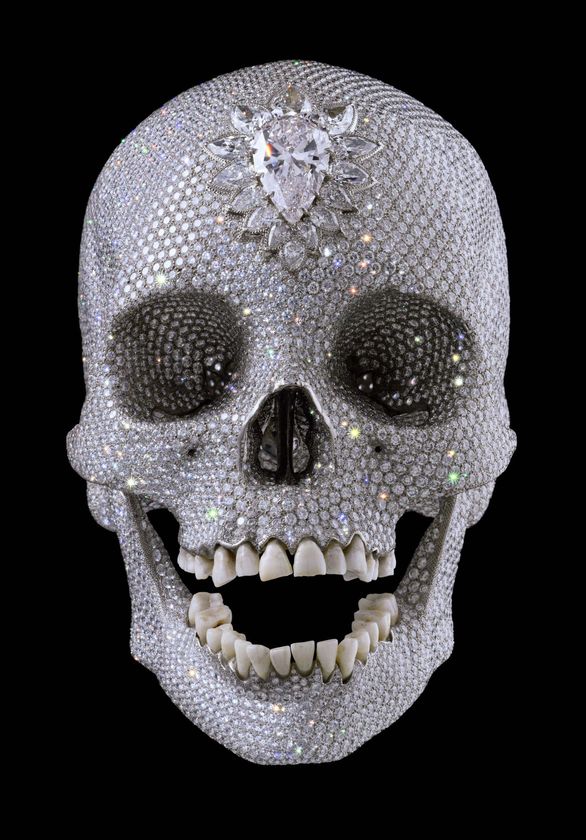
Damian Hirst - For the Love of God

Damien Hirst – For the Love of God

I came to Amsterdam for the Dreamscapes exhibition. With a few hours to spare before the opening, where I would be viewing modern painting masters, I would pay a visit to the Rijksmuseum and see some of the Old Masters.

Much to my surprise and disappointment, I found the entrance dominated by Damien Hirst and a queue. I don’t ever recall having to queue for the Rijksmuseum. The queue was one of those artifical queues you see often see in front of those superficial night clubs, that rate style above substance, continually keeping a queue of people outside for “security” reasons, while also again putting appearance before all else, fabricating a false sense of exclusitivity and popularity.

I made my way about the museum looking at all of the fine artwork and historical museum pieces, until I came across another queue. This time inside the museum, people queued for the special room where Hirst’s diamond skull was on display.

Hirst’s skull is suposedly the world’s most expensive artwork, but this is rather suspect, when you consider that he bought it back from himself. Stranger still, according to the Guardian, up to twenty workers who make his works will not have their contracts renewed even though Hirst’s gallery breaking auction earned him 130 million euro at Sotheby’s in September. Nevertheless, about half his London-based staff were told this week that their contracts will not be renewed.

“It was unexpected, especially after Hirst made a killing from the Sotheby’s sale”, a source told the Guardian.

Whether sacking staff will have much of an impact on the financial health of Hirst’s art-producing company is unclear. The workers are said to be paid only £19,000 (22,600 euro) a year. That amount pales in comparison with the prices paid for works by Hirst.

While I was curious to see Hirst’s ultimate bling, the queue looked rather dismal as well as the prospect of participating in the hype. The Netherlands have been inundated by the propaganda. It seems that not all are sold on the fanfare, especially amoungst some of the Dutch museums competing against the Hirst Rijksmuseum media machine.

Why was Hirst on display in the Rijksmuseum in the first place? Perhaps they were taken in by his comment earlier this year that he, Damien Hirst is like Rembrandt, and so promptly put him on display in the room next to “The Night Watch”.

I circumnavigated the clot of people ignoring the art about them waiting to be admitted into Hirst’s sanctum of superficiality and progressed to the next room. Superficial is the catch phrase here, as superficially the room appeared to be a continuation of museum’s permanent collection. However this was the curator’s attempt to make some relevance with Hirst’s bling by allowing him to select from their collection at his whim. Hello? What is the curator being paid to do?

Hirst seems to be astutely aware of this also, as he seized upon the opportunity presented by curator for him to make any inane comment he desires regarding the artwork he’s selected from Rijksmuseum collection. Is not the curator embaressed, or do they find him so witty? It would seem to be that Hirst is at his provocative best insulting the museum and its curator bald faced, and have them love it. “I will tell you are fools, and have you agree and tell me how genius I am for telling you so.” This is the same tactic with his artwork.

Before finally departing the Rijksmuseum shaking my head, I made a last stop by the Hirst space setup in the garden. Here you can buy all manner of diamond skull merchandise, and if you feel so inclined, leave your comments about the exhibition. Perhaps the museum, was being cautious and testing the waters. Perhaps they weren’t really so confident about their display. Why else ask for visitor feedback?

I left my comments, asking why they feel the need to copy all of the other museums. As a museum for Dutch cultural heiratage, this made them unique. As museum of modern “block buster” exhibitions, they are like all of the other me too Mc Donalds museums francised across the world.

Berliner Kunstsalon and Contemporary Art

November 2nd, 2008

Art fairs, I’ve seen a few of them. The Berliner Kunstsalon I have attended a number of times, it’s first two years and now this year. In the beginning there was much fresh and interesting work from many of the local artists who were marginalized in the Berlin art market. However since then it has transformed into the same banal copycat pap seen at all of the other art fairs.
It’s one saving grace this year was a generous soul who gave me his entrance card as he was leaving. He obviously took pity on anyone paying the eight euro entrance fee for an art fair that was totally underwhelming.

Soft gay porn seemed to make a popular showing along with the ubiquitous hastily assembled installations. While many of these mundane artworks show no hint of any thought, you of course would be derided by the art intelligentsia as ignorant and uneducated.

My friend Garth Gregory attended the opening and confirmed that the Berlin art circle spent their time discussing concepts. This is being apparent by the lack of time devoted artworks, hastily shot photos, out of focus and poorly photoshopped; offering the most inane of scene or topics, lacking any sense of composition. If you want a real challenge, try and look at the leatherman who has his todger out, and try to keep a straight face.

Technique is handwork, and therefore out, out of fashion, out of the circle of whit and intelligence of the postmodern contemporary art world. This is painfully evident in the paintings on show. No one dared raise their standards above anything mediocre lest they be labeled a craft worker. If you work with your hands too much you obviously don’t spend enough time thinking, and therefore too much time wanking.

Anja Brinkmann who attended the Berliner Salon with me made and astute observation, as we took a restive pause from trekking from floor to floor of the old power substation, warming our bones and hands on the few heating radiators to be found in that cold building. She reflected that if art reflects the zeitgeist, then what we had just viewed was indeed a mirror to our current world situation. Currently we face a crisis, (one of many) in an international finance system that is built on nothing tangible, only concepts and possibilities; the unmanifest, in short, nothing.

The populace is so anesthetised from the media assault we live in, where anything is viewable and entertainment now, shock and outrage garners little more than a whimper. Any fetish may be now labeled as art. Thus we are left with soulless banality as the pinicle of contemporary art that needs the constant assistance of concept, a blizzard of words, which like the natural phenomenon, obscures any sight and direction.

Should you be brash enough to state the obvious and name it as the emperor’s new clothes, then obviously your intellectual rigeur and wit is below par. There is a joke that is being had and snickered behind the hands of the arts intelligentsia. The joke is that clueless people looking to invest in the next big thing will buy anything, and the quest is who can exceed the others with the biggest price tag for the most pointless things sold. Banalities and whimsical curiosities are now equated with the Old Masters, because were they not also interested in profiting from their patrons who were also following fashion dictates?

All jokes repeated conceitedly, bore the audience. And this was evident as the Berliner Salon audience filed through each room barely pausing to view or engage any of the artworks. The party was over on the opening night as was evident from the dull looks in the eyes of gallerists and artists who stood listlessly by their artworks. We’d missed the party and missed the joke, by expecting so see “serious” artwork and anything of note.

Damien Hirst Like Rembrandt?

September 9th, 2008
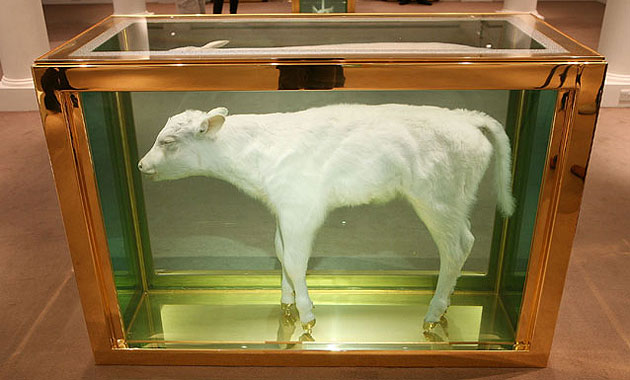
Damien Hirst - False Idol

‘False Idol’ is up for auction along with 222 other works at Sotheby’s.

Damien Hirst claims he is just like Rembrand, Velasquez and Goya. That’s quite a tall claim. While it can not be considered that he is making any serious comparison of artwork, he is most definitely making a superficial reference to lifestyle and business acumen.

He identifies himself with Rembrandt as the artwork of both, commanded high prices in their life times, enjoyed displays of opulent lifestyles and expensive homes, had large art collections, and cavorted with fashionable society.

Ok, so he could also make connections with other well known artists, performers, inventors or businessmen for that matter. It would seem that his comment is no more than a superficial grab at media attention through bombastic “sacrilegious” claims. It is completely calculated to cause a stir in conservative art circles where the Old Masters take on an almost saintly aura.

His statement is calculated as much as his artwork is to procure reaction. Damien Hirst has looked at the excesses of the modern art market, and set himself the goal of being more excessive. Excess is his artform.

He has largely stated this with his diamond encrusted skull, his intent being, to make an artwork too prohibitively expensive to buy.

With several factories situated around London and some 180 drones, he churns out his luxury brand. His works are held by some of the wealthiest collectors in the world. His comment about criticisms of his business orientation was, “A lot of people believe artists should be poor, that you’re not a real artist unless you are covered in paint with holes in your jeans.”

We can then follow this next vacuous claim that he is a populist champion for the exploited artist. Why should artists not earn well from their artwork? Why should the middlemen, galleries and dealers take up to 50% of the earnings?  Yes, discussions that all artists have had amongst themselves. Where this grab at attention seeking propaganda lacks any relevance is that his world, his earnings belong to that rarefied atmosphere of the celebrity commodity art market. In this world, only the label and price tag matters.

In a market where escalating prices seem to be almost normal, how can one possibly be even more outrageous? Cut out the middle man. This is precisely what he done. Sotheby’s auction house, will stage a ground breaking auction dedicated to 223 new works by the artist next week and is estimated to earn more that £65 million. None of it will go to his representative gallery, White Cube Gallery and nor will Sotheby’s earn any fees.

Will this change anything for the mere mortal artist? Not at all. The gatekeepers of this tightly controlled world, the arbitrators of fashionable contemporary art, are not about to let their empire end. While Damien may think his now out of their control, the rest are not. He sees himself as a grand revolutionary, a purveyor of enlightenment, but rather he is only but yet another symptom of the system, a victim of his own success.

His statements and actions thus far have as much meaning for other artists as Marie Anttonette’s purported comment, “Let them eat cake.”

Contemporary, Contemptuous, or Conceited?

December 4th, 2007

The “art establishment” once again shows how inane and conceited it is by awarding £25,000 to Mark Wallinger for a shaky 154 minute long video of a man walking around a gallery in a bear costume. He is prize winner of the 2007 Turner Prize, Britain’s foremost contemporary art award.

Lauding their lack of perspective, the Tate said that there were parallels between Wallinger and the Berlin gallery, and Michelangelo and the Sistine Chapel: “Both artists were interested in transforming spaces.”

Page 1 of 11
  • Categories

  •