News

Page 1 of 212»

Womb of Creation – Temple of Visions

December 14th, 2009
Womb of Creation - Temple of Visions

Womb of Creation - Temple of Visions

I am very pleased to announce that I have been invited to exhibit in Los Angeles, at the Temple of Visions exhibition “Womb of Creation”. I am sending two paintings for the show and will be exhibiting alongside, Martina Hoffmann, Robert Venosa, Mars-1, Oliver Vernon, HR Giger, Mark Henson, Amanda Sage, Adam Scott Miller, Carey Thompson, Satoshi Sakamoto, David Heskin, Aloria Weaver, Raul Casillas, Autumn Skye Morrison & many more.

The Temple of Visions is headed up by Jimmy Bleyer who lives in the counter culture warehouse project, the Hive. Over the last couple of years steady progress has been made with establishing the Hive and Temple of Visions with the L.A. art world. It’s mission is to raise awareness of Visionary art.

The Gallery seeks to create a spectacular environment that will bring people together in admiration of art, and in transformation of self and community. In addition to quarterly epics, the Temple will feature a monthly music & visionary culture party, a ’boutique concert series’, and several consciousness raising classes, workshops, and lectures.

www.templeofvisions.com
“The Temple is inside”

GRAND OPENING:
January 9, 2010 from 8:00pm-1:00am
719 South Spring Street
Los Angeles, CA 90014
U.S.A.
$15.00 includes entry to The Hive Gallery

Magistrates – Strychnin Gallery

November 22nd, 2009

On Friday the 13th, I attended Strychnin Gallery’s opening for the Magistrates exhibition. This is a video I shot and edited for my Fantastic Visions project. I also had the chance to catch up with Tim Roosen again who had driven a long way from Belgium to Berlin.

Magistrates features over 20 internationally renowned artists. Works in this show range from a variety of different media such as painting, etching, digital painting, photography and sculpture, making for an exhibition featuring many unique artistic positions from pop surrealism to fantastic art, special effects to lowbrow, pop art to urban art.
Dante Exhibition – Viechtach

August 11th, 2009
Non Omnis Moriar - Stephanie Henderson
Non Omnis Moriar – Stephanie Henderson

I first met Reinhard Schmid at the Dreamscapes Exhibition in Amsterdam last year. Through our correspondence since then, Reinhard came to invite me down to the opening of the “Dante’s Divine Comedy” exhibition in Viechtach.

Viechtach is a 900 year old town situated in the picturesque countryside of the Bavarian Forest. Some time ago the town of Viechtach decided to put the Alt Rathaus (Old Town Hall) to use as a gallery. Its program of exhibitions have a special emphasis upon Fantastic art. And so the “Dante’s Divine Comedy” exhibition curated by artist and publisher Claus Brusen fitted quite naturally.

The gallery is right on the old town square, which is not surprising since it was formerly the Rathaus. The upper floor of the Alt Rathaus has been superbly renovated as a large professional standard gallery space.

The exhibition looked impressive, with the selection of artwork being of an excellent quality. I arrived early before the throng and so was afforded a good overview of the exhibition. There were quite a few names I was already familiar with. It is always interesting to see new works from them.

Claus Brusen the curator of the exhibition arrived and so I finally met him face to face. There are so many of us now connected via the internet across the world, and it is not so often that we physically meet. However events like Claus’ present an opportunity to make that a reality. Claus generously gave me an exhibition catalog.

With a pen in one hand and the catalog in the other, seeking signatures was a great way to break the ice. Claus was a willing accomplice and directed many of the artists to me. By the time the opening formalities were about to commence I’d already met almost all of the exhibiting artists. There were a couple however that I’d already had contact with, such as Tim Roosen via Facebook and then Olivier Zappelli, a Swiss artist whom I had also met at the exhibition in Amsterdam last year.

Dante Exhibition Opening

The exhibition was officially opened by the Mayor, Georg Bruckner, with Reinhard introducing the artists and Horst Dieter Greyer giving us his philosophical musings on Fantastic art. It was also announced at the opening that the exhibition had already been a success to an extent, having an article with a photograph published in the Süddeutsche Newspaper. This was of special note because it is one of the largest in Germany, and it usually ignores regional events and focuses on Munich.

With the formalities finished, the mass of people which had filled the gallery to capacity on the warm Summer evening were very glad to move again and examine the artworks. Visitors had come from far and wide to see the exhibition.

After having our fill of art, we migrated down to the courtyard for our fill of Bavarian beer and food. Here over drinks and a meal was the chance for the artists to get know each other better. I had the opportunity to meet Ines Scheppach from the Neue Meister group and find out a little more about them as I had seen the group mentioned here and there around Germany. Like Ines, I talked to others and found out more of the state of our Fantastic Art movement.

The night slipped by with the beginning of new friendships and strengthening community. However many had long journeys ahead of them in the morning and so they decided to slip off to the Hotel Schmaus a few doors down from the exhibition where the town council had accommodated them.

In the morning many of the conversations continued again over breakfast. There was a lingering feeling of if only there was a little more time for us all to sit together and talk. A number of us did linger long enough in the day to see the Gläsernen Scheune, a life’s work museum and gallery from Reinhard’s father dedicated to the local Bavarian myths and stories. Those of us left in Viechtach that afternoon then congregated at the Cafe Isis where Reinhard has his Tarot series on display.

I think there will be many more exhibitions such as “Dante’s Divine Comedy” worth the the travel to Viechtach judging by the conversations and the things I saw that weekend. I believe Viechtach’s Fantastic Art project will grow from strength to strength in the years to come as their reputation as a host of professional and high quality events and exhibitions spreads.

2nd August – 27th September
Monday – Friday, 8am – 5pm
Saturday 10am – 1pm
Entry Free

Altes Rathaus
Viechtach
Bavaria
Germany

+49 9942 1661

Berlin Visionaries – Galerie III Barmstedt

March 25th, 2009
Ütersener Nachricten Zeitung

Ütersener Nachricten Zeitung

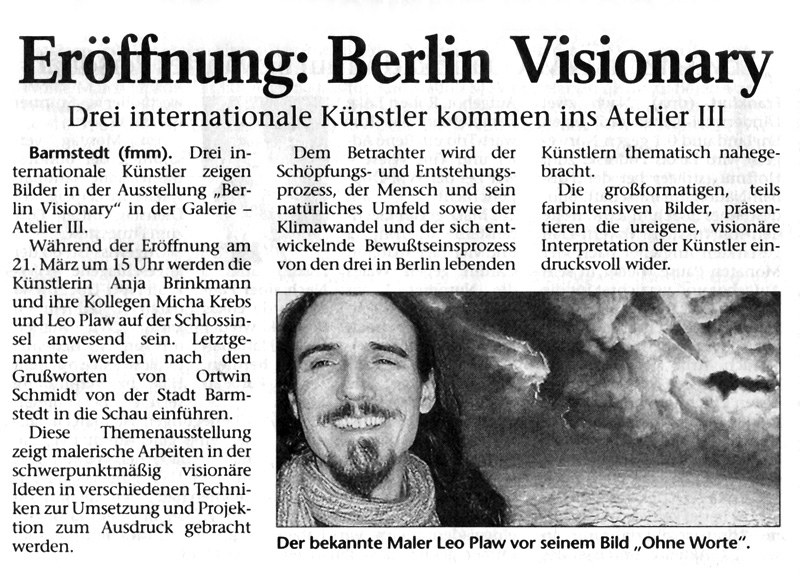
Time to finally write about exhibition opening in Barmstedt at Galerie III with Anja Brinkmann and Micha Krebs. The show went off nicely with a slew of articles in the local press. I arrived a couple of days early to be present when some of the journalists were due to visit. The gallery’s location is very picturesque, being situated on a small island on a lake. This and a number of historical buildings attract day visitors from Hamburg ensuring that that the gallery has a steady stream of visitors.

When I arrived I found the gallerist, Karin Weissenbacher, who is also an artist busy sculpting in her studio which is down the hall from the gallery. Karin had done a wonderful job of hanging our works by nicely balancing our individual styles across the rooms.

Since I was the only one of we three present, I had to meet and greet the media alone. It was a little difficult to explain Anja and Micha’s artwork, but perhaps more so my own as I had ensconced myself in my studio for half a year and talked to few people about my artwork.  While I know my own feelings and thoughts about my artwork, having to articulate these ideas on the spot to journalists required some creative thinking.

However, over the next days we discovered scant mention of anything I said in the press, but rather a rehash of the basic details sent out in the press releases. Ah well, so much for the 15 minutes of fame. At least my photo was in the papers.

The day of the opening arrived. A number of the local politicians were present with one of them giving us an introduction. It was pleasing to hear that he had dug through my website to find out a little background information to help with his speech. Micha was extremely nervous leading up to his speech but he did admirably well.

Present also was a long time internet contact, Dennis Konstantin, who lives in Hamburg with his girlfriend Natalia. They had both come out Barmstedt for the exhibition. It was our first personal meeting and we had much to discuss. I agreed to visit him at his studio the next day.

The exhibition finished well and we all had a very entertaining time with Karin and her housemates.

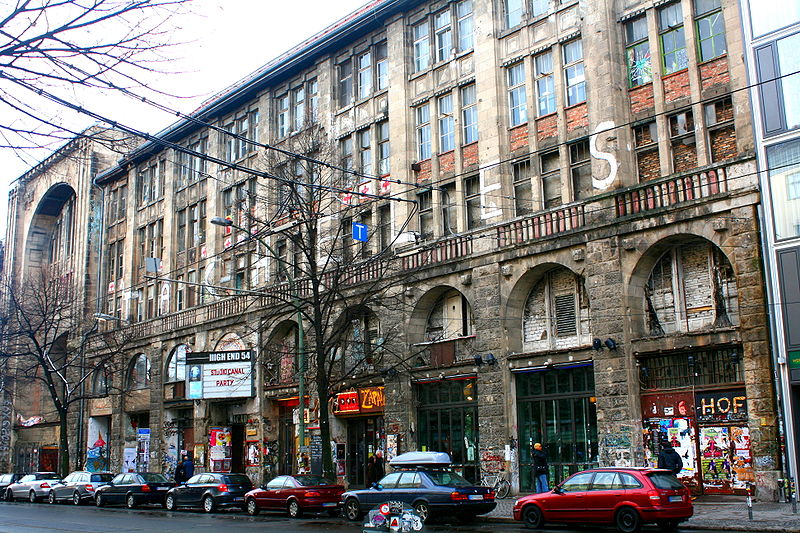
Tacheles

March 24th, 2009
Kunsthaus Tacheles Berlin

Kunsthaus Tacheles Berlin

When I first came to Berlin, I set about finding where action in the art scene was. I soon discovered a problem however. I was about ten years too late. Everybody had stories of how things were and seemed a little depressed, if not nostalgic for the heady days after the fall of Berlin Wall. There were however a few lingering corners of memorabilia clinging to Berlin like chewing gum stuck to your shoe. And just like the chewing gum, they’d been chewed up and spat out and trodden on, being devoid of their original colour and flavour.

While this all might sound rather depressing, it was rather fascinating to seek out other people’s Memory Lanes, especially for an Antipodean whose own state of origin roundly frowned on any independent art scene that got too big for its boots and would be soundly rounded upon by the local authorities for being a hotbed of radical subversive activities. One of those Memory Lanes led me to the legendary Tacheles. A large dilapidated disfunctional building which was in the center of a post Cold War Berlin art vortex of near anarchy where being radical and subversive was the norm. In short a dreamland that was a world away from my overgrown country town called Brisbane.

What was Kunsthaus Tacheles then? A former department store, then SS headquaters, a prison for French war prisoners, various offices during the DDR (GDR), neglected, partially demolished and then housing a self-organized collective of artists on Oranienburger Straße in Berlin-Mitte. One could question if the collective is indeed self-organized. There used to be all manner of events and parties hosted in the building and a constant stream of artists coming and going, some leaving there mark around the complex such as with the sculptures in the empty space behind the building. Today it is mostly the street “artists” leaving their marks on the walls with their graffiti.

I met a few people who had studio spaces in the building, and came to know one artist in particular. And so I came to be informed of all of the internal strife that forms its colourful history as an artists studio complex. I tried for a while in vain to land myself a studio space there, but in the end gave up, as I discovered a more lively scene over in Friedrichshain that was not the focus of morbid tourist curiosity.

Since 2003 when I first explored it, little seems to have changed. Strife still abounds as the collective is trying to secure their future in the building by purchasing it from the owners, with whom they’ve had a very rocky relationship.

The collective is seeking €3.5 million in funding. However, there does not appear to be any suggestion of where that is coming from. There is also a dispute over the status of the lease since the beginning of the year.

Although I rarely go to the Tacheles these days, I would miss a place that has become part of my own Memory Lane.

Exhibitions in Germany

February 23rd, 2009

After a hiatus it is time to exhibit again. First is a group show with Anja Brinkmann and Micha Krebs just outside of Hamburg. All three of us will be show a selection of recent work. Having all often met together in Berlin and discussed our art, this is our first group exhibition together. Hopefully there will be more to come. The Gallerist Karin Weissenbacher has been very accommodating of us.

Galerie Atelier III
im Gerichtsschreiberhaus
Schlossinsel Rantzau
Barmstedt
Germany
21st March to 3rd May 2009

http://www.galerie-atelier-3-barmstedt.de/

The next will be with the Society for the Art of Imagination. The show is called Sacred Art. The Gallery where the artwork will be shown is an extension of a Benedictine Monastery and the monks are also offering to show some selected works inside the Abbey, which receives many visitors.
Sacred Art Exhibition
at the Lofthouse Gallery
Wessobrunn
Germany
4th April to 7th June 2009

I have also recently received invitations to join a group show in Paris with the International Fantastic Art Association (IFAA) and another in Montreal. More information will be posted when it is at hand.

The year is off to an excellent start!

William Blake Retrospective – Tate Gallery

January 3rd, 2009
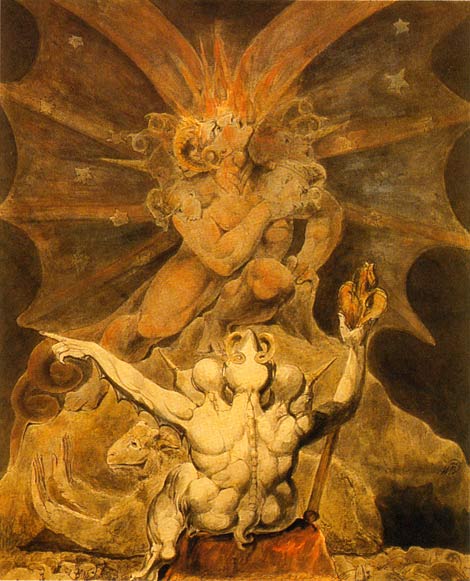
William Blake - Beast
William Blake – Beast

The Tate Britain is to recreate that William Blake’s first and only exhibition – exactly 200 years after it was staged in 1809 – and will bring together at least nine of the surviving 11 works from the 16 in the original show. It will also republish Blake’s Descriptive Catalogue, now regarded as a fascinating and significant commentary on the London artworld of his day. The 1809 exhibition, held in his brother’s Soho hosiery shop in Golden Square, Soho, proved a turning point in the artist’s career. The paintings, according to the only critic who bothered to review the show, were wretched and the artist suffered from “the wild effusions of a distempered brain”. Embittered by its appalling reception, he withdrew even more from the art world into solitary eccentricity.

Most Blake exhibitions have always tended to focus on the illuminated books. But this exhibition shows us Blake as he wanted to be seen. The image Blake wanted to project in that 1809 exhibition was of an ambitious public painter of historical and religious subjects, who yearned to sweep away what he regarded as a venal and corrupt art world – rather than of the quintessential outsider, as he is thought of now.

Blake was a Christian who sought to bring out the religion’s repressed prophetic side. This meant sympathising with revolutionary politics, even when such thought was atheist. Above all it meant rejecting all forms of institutional church. This is the real heart of Blake’s radicalism: the insistence that Christianity is meant to be free of institutional control.

The message throughout his work is that the true religious vision is inimical to the established church, to all organised religion and all orthodoxy. He announced a new era of direct communion with God. The notion of a divine principle in everyone was the basis of his concept of Imagination. This higher form of perception was by means of art, not science. The core belief was that Christianity was the true religion of humanity, of world-affirmation and of freedom. He saw Christianity as a religion of liberty and utopian love. He sometimes seems to advocate free love, the abolition of all moral constraints.

Blake’s father was an industrious London tradesman, who sent him to drawing school when he was ten and apprenticed him to James Basire, a well-known engraver, five years later. Blake was to remain an engraver for the rest of his life, subsidising his experimental work with his commercial income. Engravers were viewed as skilled workers rather than artists and, for a long time, could not be members of the Royal Academy because that was, according to its documents, “incompatible with justice and a due regard to the dignity of the Royal Academy”. When Blake was finally admitted, he called them “a pack of Idle Sycophants”. He reserved particular venom for Joshua Reynolds, the first president of the Academy, saying, “This man has been hired to depress Art”. He saw the Academy’s training system, based on the copying of classical statues and paintings, as suppressing imagination. He felt the whole system was tied up with patronage and “where any view of Money exists Art cannot be carried on, but war only”.

Blake died on August 12, 1827, and was buried in an unmarked grave in the dissenters’ graveyard at Bunhill Fields, East London. In the years that followed his death only a handful of friends, pupils and followers kept his memory alive. When the Pre-Raphaelite movement came to prominence Blake became fashionable.

The consequence was the creation of a Blake cult and the uprising of a number of ardent collectors of his books, his engravings, and such of his rare drawings and pictures as happened to come into the market; exhibitions were held at the Burlington Fine Arts Club, at Boston, and elsewhere; several editions of his poems were published, and books were ‘written about his mystical art in. England and in Germany.

According to Gilchrist, his biographer, Blake was well versed in the doctrines of the Gnostics, and his own personal mythology contains many points of cohesion with several Gnostic myth themes (for example, the Blakean figure of Urizen bears many resemblances to the Gnostic Demiurge). However, efforts to dub Blake a “Gnostic” have been complicated by the complex nature and colossal extent of Blake’s own mythology, and the variety of myths and themes that are referred to as “Gnostic”; thus, the exact relationship between Blake and the Gnostics remains a point of scholarly contention, though a comparison of the two often reveals intriguing points of correspondence.

To Blake indeed the facts were nothing, except as ground-works for his famous “Visions”, which he regarded it as his duty and privilege to translate into line and colour for the enlightenment of the world.

Alex Grey’s Chapel of Sacred Mirrors Closes Temporarily

December 25th, 2008

The Chapel of Sacred Mirrors (CoSM) in New York will close at the end of this month. While the chapel will close with a New Year’s Eve party, the project will not come to an end.

Through the chapel’s corporation and with help from donors, they have bought a 40-acre plot of land in the town of Wappinger, 65 miles north of New York City and just a 20 minute walk from the MetroNorth train stop at New Hamburg. Here they plan to rebuild the chapel and develop an interfaith retreat center. There, eventually, they intend to construct a four story, domed temple to house the Sacred Mirror paintings and provide a place for rites of cosmic consciousness. There will also be studios, workshops, conferences, retreats, offices, visionary art exhibitions and an installation of the Chapel of Sacred Mirrors permanent art collection which has become a context for a growing community.

One of the criteria for the Greys for CoSM’s site selection, was that the land required rehabilitation. On the plot they selected were a number of old oil tanks. This required that the contaminated soil be removed and the surrounding treated.

Chapel of Sacred Mirrors (CoSM map)

Chapel of Sacred Mirrors (CoSM map – click to view)

Founded by the Alex Grey, and his wife, Allyson Grey, the chapel is a curious, combination of art gallery and New Age temple. The main attraction is an installation of allegorical paintings by Alex Grey that, in the context of a carefully orchestrated theatrical environment, is designed to transport paying visitors into states of ecstatic reverence for life, love and universal interconnectedness.

The Chapel of Sacred Mirrors proper is currently a long hall with red walls hung with a series of 20 life size paintings of standing human figures that Alex made in the early ’80s. They include pictures of naked racial types; images of people with skin peeled off to reveal underlying anatomical structures; and figures that have almost completely dissolved into patterns of circulating light. At one end of the hall, a radiant Jesus hangs next to a glowing Sophia. Grey’s 2006 portrait of the discoverer of LSD, Albert Hofmann, is displayed on an easel in the middle of one of the chapel’s other rooms. It’s called “St. Albert and the LSD Revelation Revolution.”

Hundreds have attended the Grey’s regularly sponsored Entheocentric Salon, an all-night party involving, according to the Chapel’s guidebook, “live painting, video projections, local and international DJs and musicians, live performances, lectures and visionary conversations.”

Dreamscapes Book and Exhibition – Amsterdam 2008

December 12th, 2008
Dreamscapes 2009 - The Best of Imaginary Realism

Dreamscapes 2009 – The Best of Imaginary Realism

The new Dreamscape book has been released and I travelled to Amsterdam for the book launch and exhibition. The new Dreamscapes 2009 book represents 52 artists working in imaginary realism from around the world and has 164 pages in full color. As always, the print quality is from the highest level.
My friend Ella Buzo from Cabinodd was one of the organizers for the exhibition. She was working with Marcel Salome the publisher and director of the project. It was Marcel who greeted me first as I entered the door to the exhibition. He said he recognized me from images on the internet and welcomed me warmly. And so it was throughout the evening, finally meeting people who were until that time were no more than a data stream on my computer or perhaps images in a book. Meeting all of these artists certainly was one of the things that attracted me to the event, but more overly it was a chance to see a little bit of Fantastic art history in the making.

The book is the third in the Dreamscapes series. I have the two previous Dreamscape books. The project has continued to grow in strength and mature. A large hall was rented to accomodate all of the works for the exhibition. It looked impressive. Dreamscape unites art movements like magic realism, fantastic realism and surrealism under the collective name Imaginary Realism and brings them with various projects to the worldwide and well deserved attention.

I struggled to look at all of the artwork in detail as much of the evening was spent meeting people. What I did see was of superb quality. Amongst the new faces were one or two that I already knew, such as Brigid Marlin, Igor Grechanyk and Rardy Van Soest.

Many artists had brought books and catalogues to give away or swap. I am very pleased to say that I collected a number of them myself, including a copy of Dreamscapes presented to me by Marcel himself. I had also brought my copy of Jon Beinart’s Metamorphosis book along to gather a few more signatures.

Dreamscapes Exhibition - Amsterdam 2008

Ella Buzo, Marcel Salome, myself at the Dreamscapes Exhibition, Amsterdam

With so many artists to talk to time was quickly gone and the exhibition opening came to an end. However we all made our way over to a boat restaurant. Brigid called me over to join her table, with Steven Kenny, Rene Zwaga, his wife and Rardy Van Soest. Again time passed quickly and people eventually made their way home.

Many artists had made long journeys to attend, some longer than mine from Berlin to Amsterdam. The journey was well worth the effort to meet the artists and see their artwork. I hope we see many more such events to come.

Participating artists:
Michael Parkes · Lukas Kandl · Bruno Di Maio · Gerard Di Maccio · Herman Smorenburg · Michael Cheval · Ans Markus · Bodi · Fabrizio Riccardi · Victoria Francisco · Imke Meester · Richard van der Koppel · Jake Baddeley · Bas Sebus · Jolanda Richter · Ray Donley · Gabriela Garza-Padilla Adam Rote · Daniel Merriam · David Bowers · Gabriel Meiring · Igor Grechanyk · Jean Thomassen · Kinuko Y. Craft · Micha Lobi · Michael Hiep · Olivier Zapelli · Patricia van Lubeck · Paul Jaarsma · Reinhard Schmid · Rene Zwaga · Shiori Matsumoto · Siegfried Zademack · Steven Kenny · Wim Kuenen · Zeljko Djurovic · Christophe Vacher · Sjaak Kieft · Helene Terlien · Ton Haring · Peter Gric · Sergei Aparin · Viktor Safonkin · Yu Sugawara · Iurie Matei · Boris Shapiro · Tomasz Kopera · Michael Maschka · Imke Meester

For more information about the exhibition and the new Dreamscapes book visit:
www.imaginaryrealism.com

Damien Hirst – The Rijksmuseum – and the Ultimate Bling

December 11th, 2008
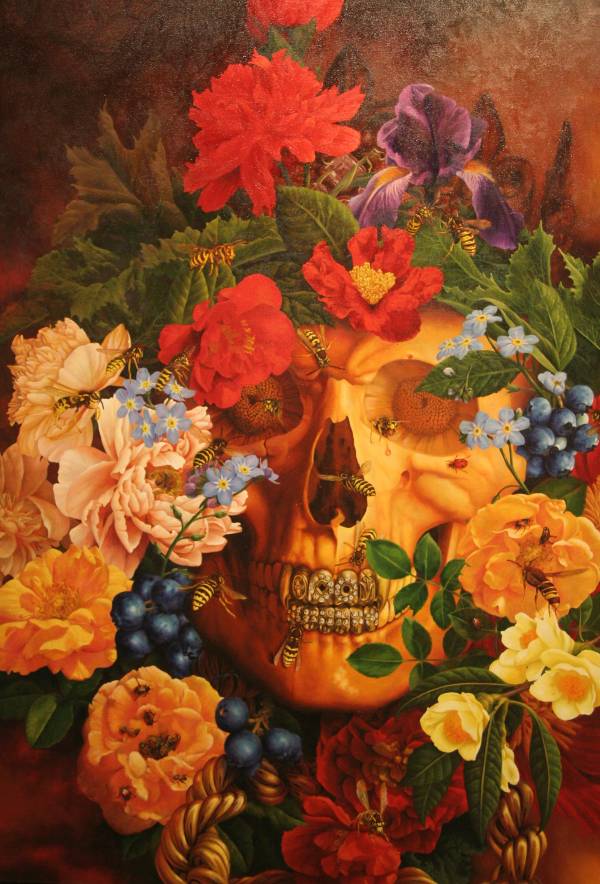
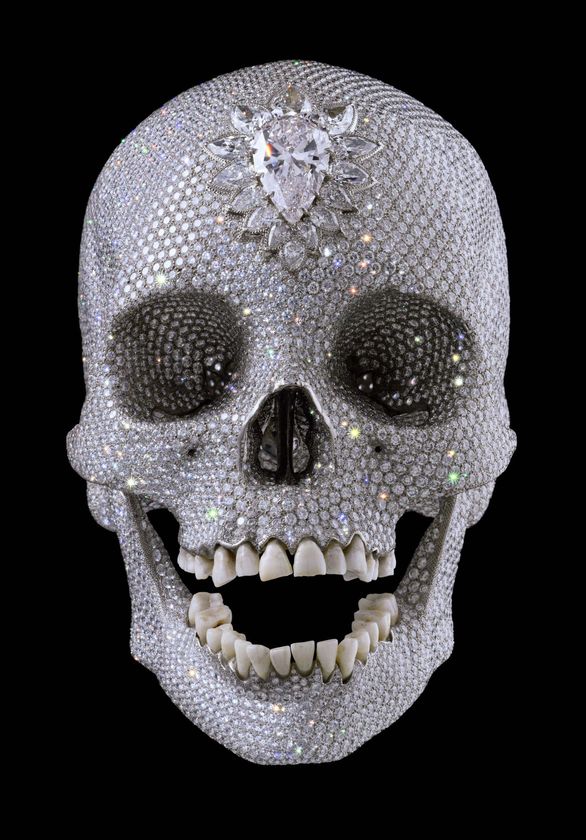
Damian Hirst - For the Love of God

Damien Hirst – For the Love of God

I came to Amsterdam for the Dreamscapes exhibition. With a few hours to spare before the opening, where I would be viewing modern painting masters, I would pay a visit to the Rijksmuseum and see some of the Old Masters.

Much to my surprise and disappointment, I found the entrance dominated by Damien Hirst and a queue. I don’t ever recall having to queue for the Rijksmuseum. The queue was one of those artifical queues you see often see in front of those superficial night clubs, that rate style above substance, continually keeping a queue of people outside for “security” reasons, while also again putting appearance before all else, fabricating a false sense of exclusitivity and popularity.
I made my way about the museum looking at all of the fine artwork and historical museum pieces, until I came across another queue. This time inside the museum, people queued for the special room where Hirst’s diamond skull was on display.

Hirst’s skull is suposedly the world’s most expensive artwork, but this is rather suspect, when you consider that he bought it back from himself. Stranger still, according to the Guardian, up to twenty workers who make his works will not have their contracts renewed even though Hirst’s gallery breaking auction earned him 130 million euro at Sotheby’s in September. Nevertheless, about half his London-based staff were told this week that their contracts will not be renewed.

“It was unexpected, especially after Hirst made a killing from the Sotheby’s sale”, a source told the Guardian.

Whether sacking staff will have much of an impact on the financial health of Hirst’s art-producing company is unclear. The workers are said to be paid only £19,000 (22,600 euro) a year. That amount pales in comparison with the prices paid for works by Hirst.

While I was curious to see Hirst’s ultimate bling, the queue looked rather dismal as well as the prospect of participating in the hype. The Netherlands have been inundated by the propaganda. It seems that not all are sold on the fanfare, especially amoungst some of the Dutch museums competing against the Hirst Rijksmuseum media machine.

Why was Hirst on display in the Rijksmuseum in the first place? Perhaps they were taken in by his comment earlier this year that he, Damien Hirst is like Rembrandt, and so promptly put him on display in the room next to “The Night Watch”.

I circumnavigated the clot of people ignoring the art about them waiting to be admitted into Hirst’s sanctum of superficiality and progressed to the next room. Superficial is the catch phrase here, as superficially the room appeared to be a continuation of museum’s permanent collection. However this was the curator’s attempt to make some relevance with Hirst’s bling by allowing him to select from their collection at his whim. Hello? What is the curator being paid to do?

Hirst seems to be astutely aware of this also, as he seized upon the opportunity presented by curator for him to make any inane comment he desires regarding the artwork he’s selected from Rijksmuseum collection. Is not the curator embaressed, or do they find him so witty? It would seem to be that Hirst is at his provocative best insulting the museum and its curator bald faced, and have them love it. “I will tell you are fools, and have you agree and tell me how genius I am for telling you so.” This is the same tactic with his artwork.

Before finally departing the Rijksmuseum shaking my head, I made a last stop by the Hirst space setup in the garden. Here you can buy all manner of diamond skull merchandise, and if you feel so inclined, leave your comments about the exhibition. Perhaps the museum, was being cautious and testing the waters. Perhaps they weren’t really so confident about their display. Why else ask for visitor feedback?

I left my comments, asking why they feel the need to copy all of the other museums. As a museum for Dutch cultural heiratage, this made them unique. As museum of modern “block buster” exhibitions, they are like all of the other me too Mc Donalds museums francised across the world.

Page 1 of 212»
  • Categories

  •